Can Light Move Matter? — Evanescent Fields, Optical Forces and Particle Transport.
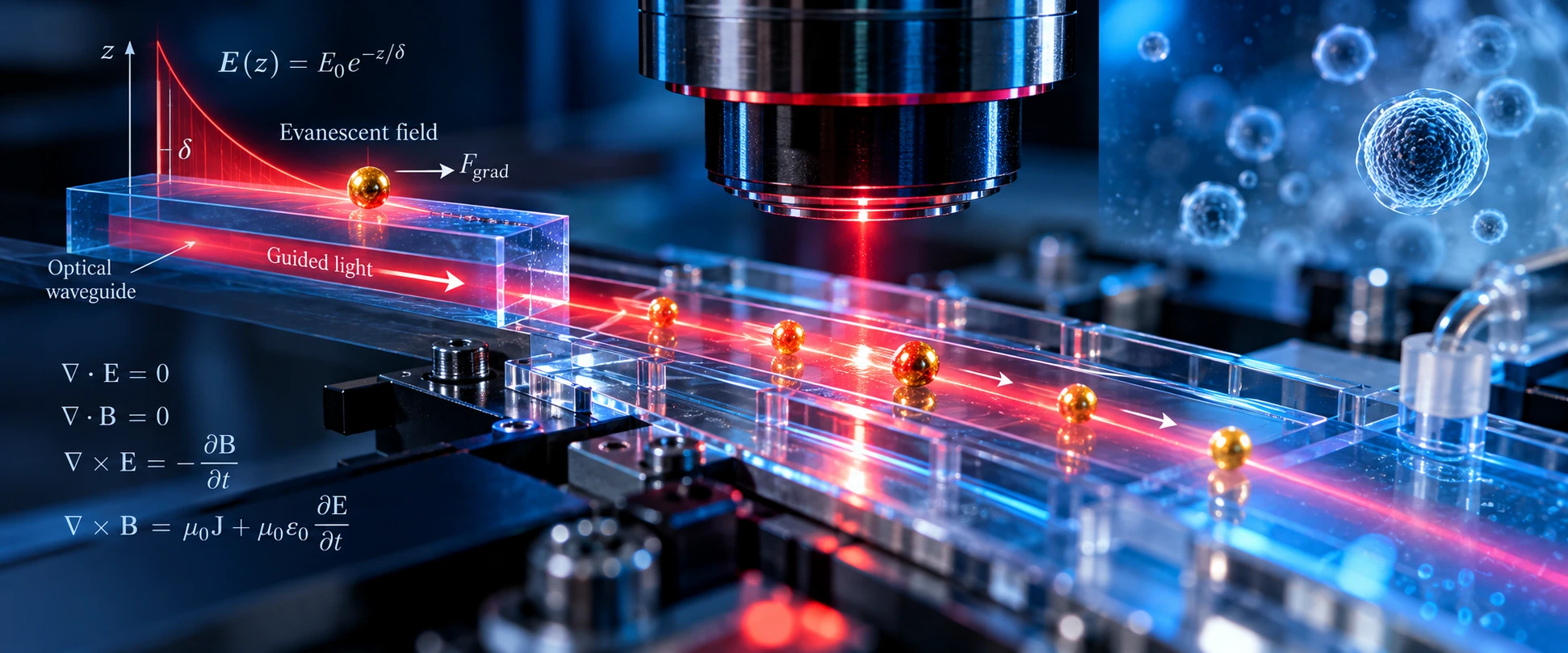
Light carries energy and momentum. Under suitable conditions, its interaction with matter can do more than illuminate or heat: it can exert forces, confine particles and drive their motion. This becomes particularly intriguing near the surface of an optical waveguide, where an electromagnetic field extends into the surrounding medium without propagating away from the interface in the usual manner.
The central question is deceptively simple: can an evanescent optical field transport microscopic particles along a surface? The more demanding question is what actually causes any observed motion. Optical momentum transfer, field gradients, thermal effects, hydrodynamic flows and Brownian fluctuations may all contribute. Identifying their relative roles is an experimental problem, not something that can be settled by a compelling image alone.
1. LIGHT CARRIES MOMENTUM
For a photon in vacuum, energy and momentum are related by
E = hν = hc/λ, p = E/c = h/λ.
Here h is Planck's constant, ν the optical frequency and λ the vacuum wavelength. In a material medium, electromagnetic momentum and mechanical momentum transfer require a more careful treatment than simply replacing c with the phase velocity. The essential point remains: an optical field can exchange momentum with matter.
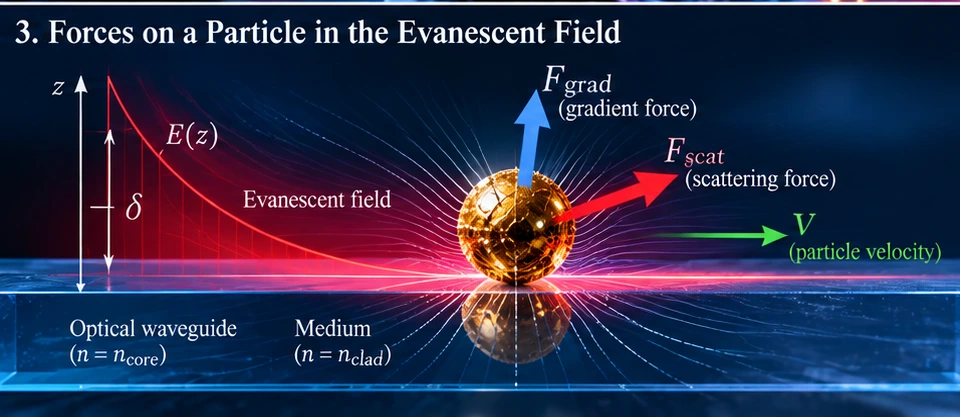
For a small polarizable particle, a useful qualitative distinction is between a gradient force, associated with spatial changes in optical intensity, and a longitudinal or propulsion force, associated with momentum transfer along the direction of the guided optical field. The actual force depends on particle size, material, absorption, polarization, the local field and proximity to the surface.
2. AN EVANESCENT FIELD AT AN INTERFACE
Consider total internal reflection at an interface between two transparent media, with refractive indices n1 > n2. For a plane wave incident from medium 1, total internal reflection is possible when
θ > θc = arcsin(n2/n1).
Although no propagating transmitted plane wave carries energy away into medium 2, the electromagnetic field does not terminate abruptly at the interface. Its amplitude decays exponentially with distance z into the lower-index medium. For the idealized planar-interface model, the intensity obeys
I(z) = I(0) exp(−2κz),
κ = k0 [n12 sin2θ − n22]1/2, k0 = 2π/λ0.
The corresponding intensity penetration depth is δI = 1/(2κ). This expression describes a simple total-internal-reflection geometry; the evanescent tail of a real guided mode is determined by its modal propagation constant and waveguide structure.
A particle in this near-surface field may experience a force toward the higher-intensity region, typically toward the interface for a particle with a positive effective polarizability in the relevant regime, while longitudinal momentum transfer may drive motion along the waveguide. Neither tendency by itself guarantees sustained transport: adhesion, surface interactions and fluid dynamics matter.
3. FROM PHYSICS TO AN EXPERIMENT
To investigate near-surface particle motion, optical power must first be coupled into a guided mode. A grating can supply the additional in-plane wave vector needed for phase matching. In an idealized coupling geometry, the condition can be written as
β = k0 ninc sinθ + m(2π/Λ),
where β is the propagation constant of the excited mode, ninc the incident-medium refractive index, Λ the grating period and m an integer diffraction order. The equation describes the principle; it does not establish the exact grating geometry of the historical apparatus.
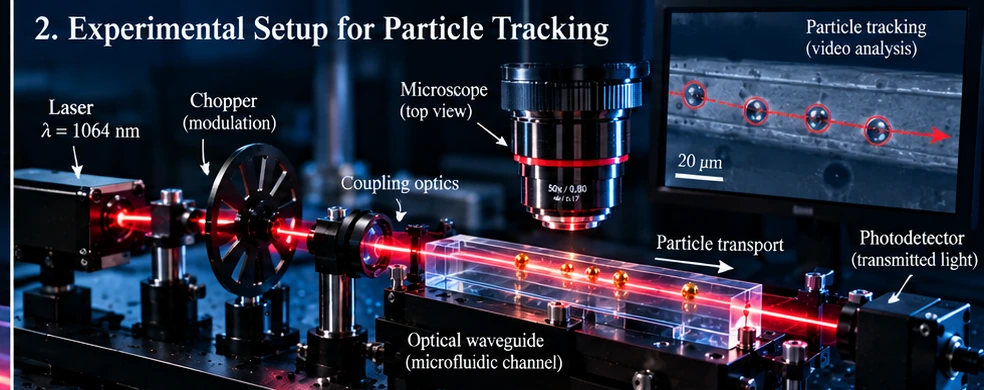
The experiment then becomes a combination of photonics and microscopy: launch light into the waveguide, introduce particles near the surface, observe their trajectories and compare motion under different illumination conditions. A displacement along the optical propagation direction is interesting, but it is not automatically proof that optical radiation pressure is the only driving mechanism.
4. BUILDING THE EXPERIMENT — WESTERN ONTARIO, 2008–2009
During research work at the University of Western Ontario in 2008–2009, I investigated the motion of gold particles near an optical waveguide surface under illumination from a 1064 nm Nd:YAG laser. The work involved a BK7 (Schott) glass-based waveguide, optical coupling, microscopy and video-based particle tracking. The experimental setup was developed under practical constraints, with much of the supporting hardware assembled or adapted locally.
The microscope incorporated salvaged Zeiss components and a separate objective. A camera assembled around a webcam CCD provided video recordings, and a custom C++ program was used to follow particle trajectories in MOV files. A homemade mechanical optical chopper periodically interrupted illumination, enabling comparisons between illuminated and non-illuminated intervals.
Directional particle motion near the surface was observed. The unresolved question was how much of that behavior could be assigned to direct optical forces rather than heating-related processes such as convection or thermophoresis, or to other near-surface effects. Switching the light on and off was a useful diagnostic, but not by itself a complete separation of these mechanisms. The investigation was not brought to a fully quantified conclusion before my work moved in a different professional direction.
Three kinds of evidence should therefore remain separate: the observed directional motion, the experimental methods remembered and described here, and the still-open physical interpretation. This distinction is particularly important when revisiting unfinished research years later.
5. WHY THE MECHANISM MATTERS
A measured particle velocity is not itself an optical force measurement. For example, a simple bulk Stokes-drag estimate, F = 6πηav, applies to a sphere of radius a moving slowly through a fluid of viscosity η, sufficiently far from boundaries. Close to a waveguide surface, hydrodynamic wall corrections, particle–surface interactions and possible slip or sticking events can make that estimate inadequate.
Thermal effects also require explicit controls. Absorption by particles, coatings or nearby structures can produce local temperature gradients; these may drive thermophoresis or fluid motion. Brownian motion introduces stochastic fluctuations that require statistical treatment of trajectories rather than interpretation of a single path. A convincing analysis would compare repeated measurements across optical power, modulation frequency, particle properties, polarization and environmental conditions, while independently constraining temperature and flow.
6. FROM PARTICLE TRANSPORT TO MICROFLUIDIC BIOSENSING
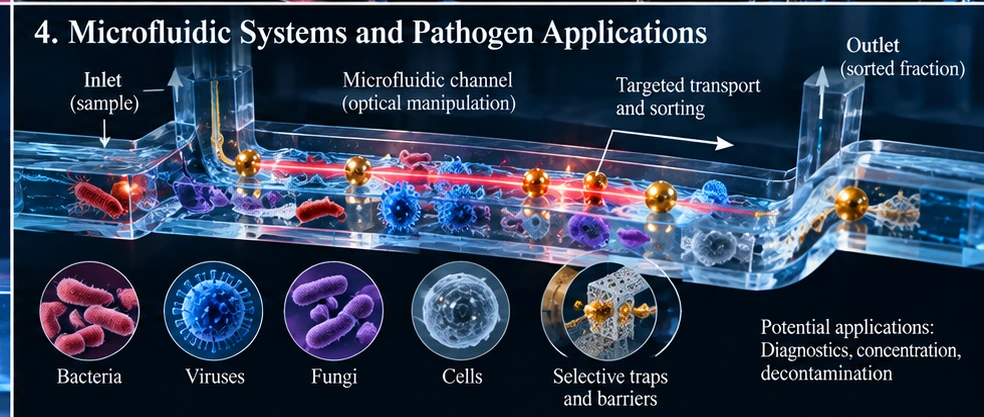
Waveguide-based optical manipulation suggests possibilities for integrated microfluidic systems. In principle, light could help position or transport suitably chosen particles, while functionalized surfaces or optical readout methods could contribute to detection. Such an approach might be relevant to bioanalytical workflows involving cells, microorganisms, labeled particles or pathogen-associated targets.
However, transport is not the same as identification, selective capture or pathogen detection. Each additional function requires its own physical mechanism, specificity controls, validation and, ultimately, consideration of the intended diagnostic or regulatory context. The historical experiments described above did not establish a pathogen-sorting or biosensing device.
7. QUESTIONS STILL WAITING FOR ANSWERS
- How strongly do local temperature gradients, thermophoresis and fluid convection contribute to the observed transport?
- How does particle velocity depend on launched optical power and the actual guided-mode intensity?
- What changes with particle size, material, shape, absorption and polarizability?
- How do waveguide modes, polarization, surface quality and coupling efficiency affect the result?
- What roles are played by adhesion, electrostatic interactions and near-wall hydrodynamic drag?
- Can controlled illumination modulation distinguish optical and thermal response times?
- How should Brownian motion and trajectory-to-trajectory variability be quantified?
- Can forces be calibrated independently rather than inferred from uncorrected particle velocities?
- Could the same platform combine controlled transport with a genuinely selective optical sensing function?
- Can a physicist find a sponsor willing to finance the answers to questions 1–9?
Theoretical predictions are welcome. Experimental verification is preferred.
REFERENCES AND FURTHER READING
[1] A. Ashkin, “Acceleration and Trapping of Particles by Radiation Pressure,” Physical Review Letters 24, 156–159 (1970). DOI: 10.1103/PhysRevLett.24.156.
[2] S. Kawata and T. Sugiura, “Movement of micrometer-sized particles in the evanescent field of a laser beam,” Optics Letters 17, 772–774 (1992). Optics Letters.
[3] L. Novotny and B. Hecht, Principles of Nano-Optics, 2nd ed., Cambridge University Press (2012). Publisher.
[4] A. Ashkin, J. M. Dziedzic, J. E. Bjorkholm and S. Chu, “Observation of a single-beam gradient force optical trap for dielectric particles,” Optics Letters 11, 288–290 (1986). DOI: 10.1364/OL.11.000288.
Historical note. This article is a retrospective account of exploratory work carried out at the University of Western Ontario in 2008–2009. Its conceptual illustrations are not experimental records, and the work described here should not be confused with independent experiments or apparatus developed by other researchers.