DA VINCI PATH
From Idea to Impact.
The DA VINCI PATH is a decision model for navigating the journey from a technical idea to real-world impact. It connects technical assessment, intellectual property, protection strategy and transfer within one continuous path.
A patent is not the destination. Impact is.
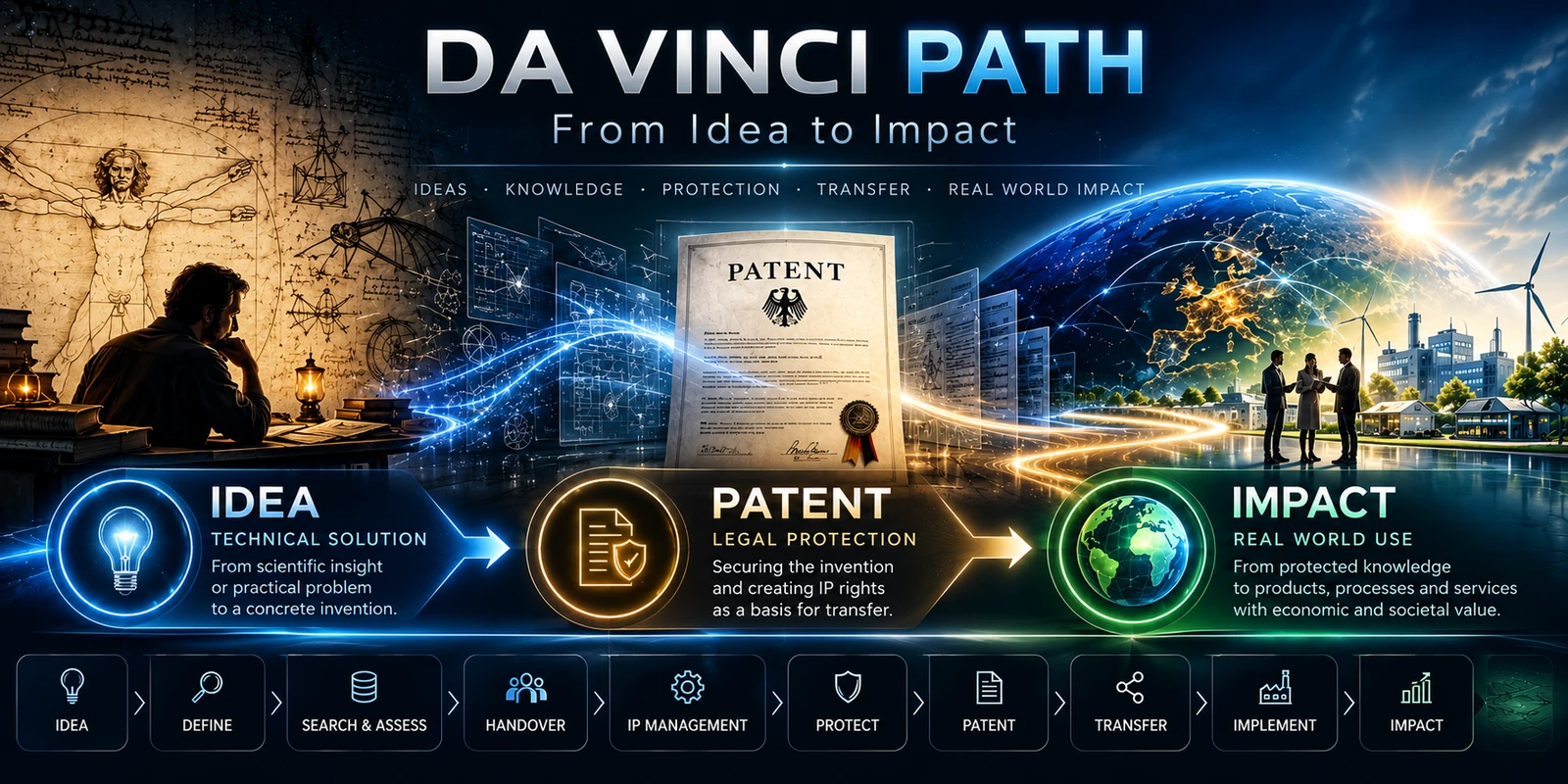
ONE PATH — DIFFERENT RESOLUTIONS
The DA VINCI PATH is not a linear checklist. It is one continuous decision path that can be viewed at different levels of detail — from a simple overview to individual decision points, feedback loops and professional IP-management processes.
At every stage, the same principle applies:
INPUT → EVIDENCE → DECISION → CONSEQUENCE
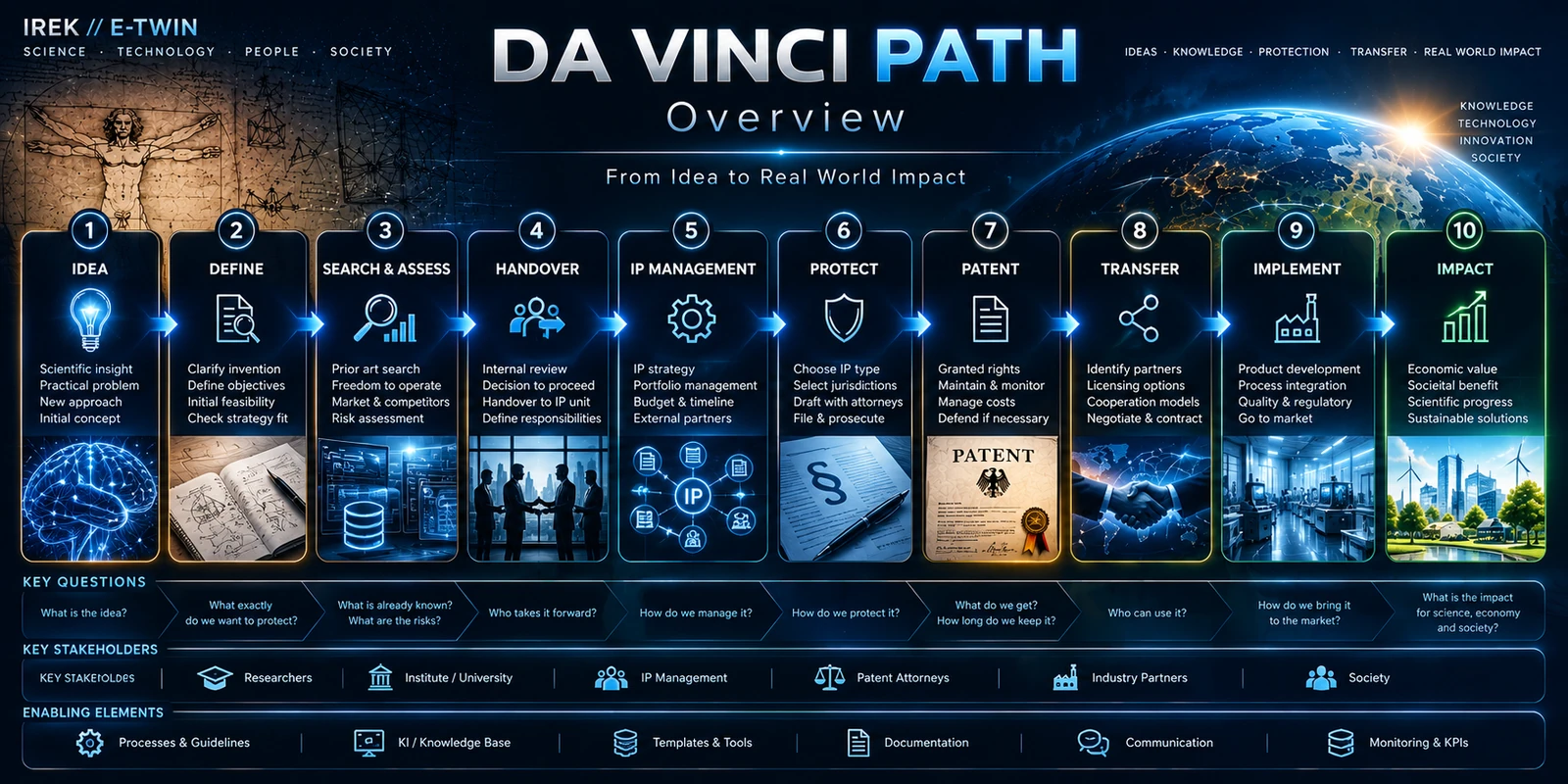
THE LANGUAGE OF THE PATH
The DA VINCI PATH uses a small set of terms to describe roles, decisions and levels of detail consistently.
DVP — DA VINCI PATH
The complete decision model from IDEA to IMPACT.
LEONARDO — THE INVENTOR
Leonardo represents the scientist, engineer or inventor moving through the Path. He develops the technical solution, contributes the technical knowledge and remains involved whenever his expertise is required.
LDP — LEONARDO DECISION POINT
A defined decision point at which available evidence determines whether the Path progresses or another consequence follows.
ELDP — EXTENDED LEONARDO DECISION POINT
A connected set of decisions that cannot reasonably be separated into a simple YES/NO question. One example is the strategic relationship between WHY × WHO × HOW × WHERE.
LDP = one decision · ELDP = connected decisions · DVP = the complete Path · Leonardo = the inventor
HANDOVER — THE PERSPECTIVE CHANGES
At HANDOVER, Leonardo transfers not only the description of the invention, but also the information required to manage it: inventor contributions, affiliations, cooperation context, known agreements, prior art and other relevant circumstances.
Leonardo remains the technical expert. Responsibility for navigating the institutional IP process now shifts to IP Management.
IP MANAGEMENT — THE BACKBONE
From this point onward, IP Management becomes the coordinating backbone of the Path. It connects technical expertise with prior-art research, institutional assessment, protection strategy, patent professionals and later transfer activities.
Leonardo does not disappear. He returns whenever technical clarification, evidence or scientific judgement is required. Patent attorneys, authorities and potential transfer partners enter the Path when their expertise or decisions become relevant.
LEONARDO = TECHNICAL EXPERT
IP MANAGEMENT = PROCESS OWNER
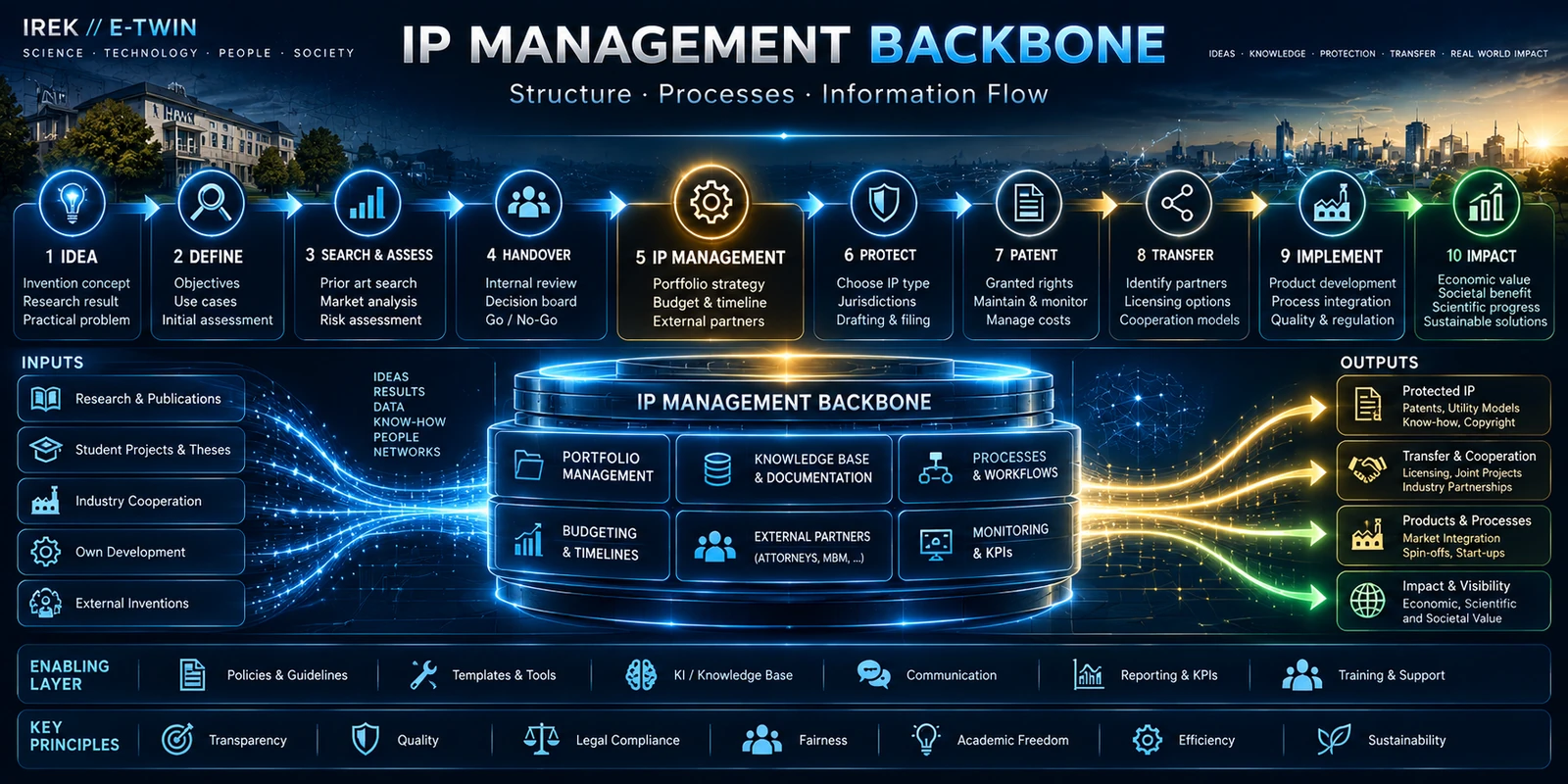
FROM INFORMATION TO STRATEGY
Managing IP means more than asking whether an invention can be patented. Technical evidence, the IP landscape, possible applications, potential partners, development requirements and economic context must be considered together.
The result is not a prediction. It is an evidence-based strategy recommendation.
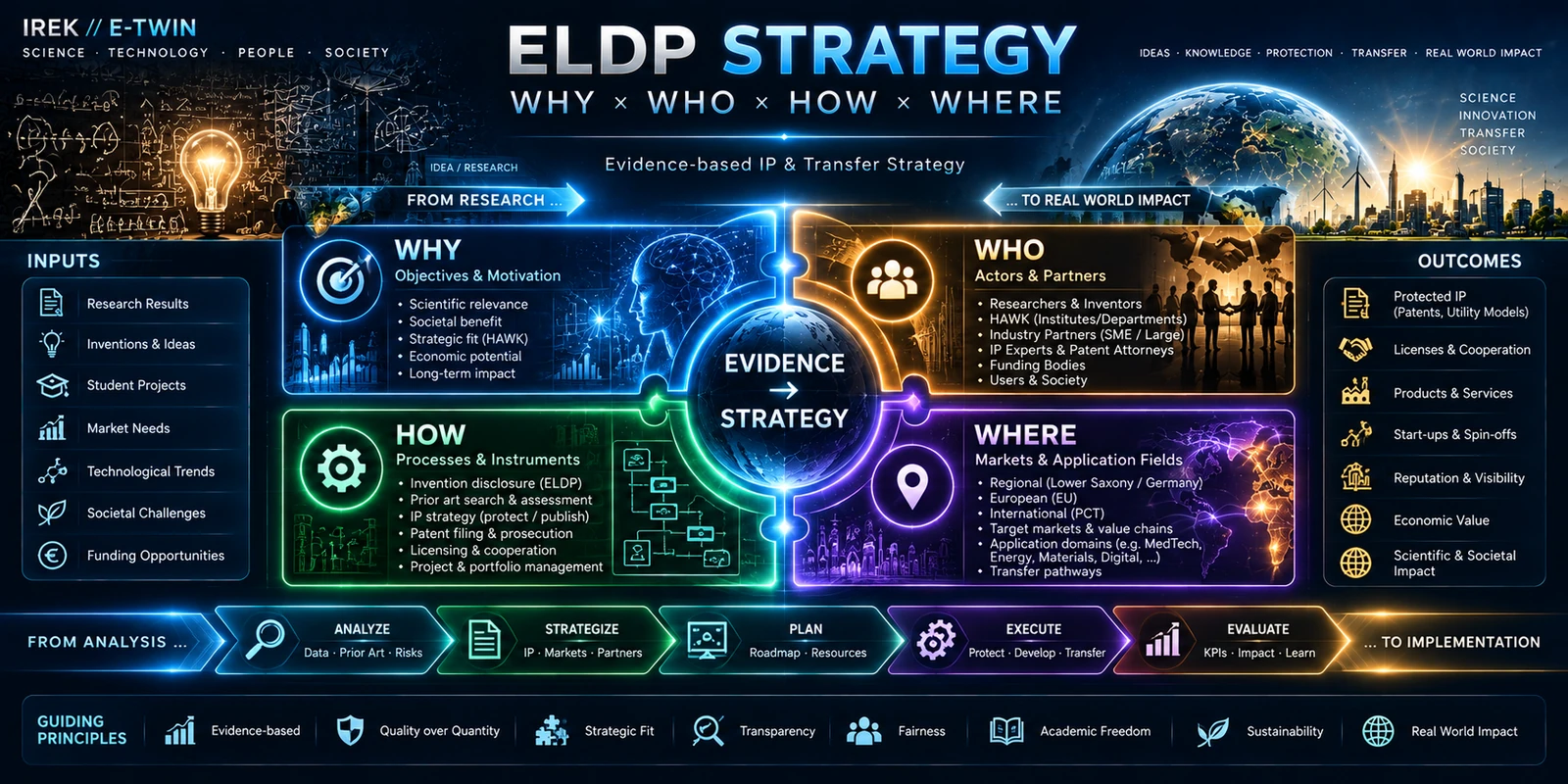
ELDP // STRATEGY
WHY × WHO × HOW × WHERE
Protection strategy cannot be reduced to a single question such as “Where should we file a patent?” The relevant decisions are interconnected and must be considered together.
WHY — What impact are we trying to achieve?
WHO — Who could use, develop, license or benefit from the invention?
HOW — Which protection and exploitation strategy supports that objective?
WHERE — Which territories are relevant for protection, partners, markets and future use?
Changing one element may change the others. A potential industrial partner may alter the relevant territories; the intended application may change the protection strategy; costs and development requirements may change what is realistically achievable.
This is why the DA VINCI PATH treats these questions as an Extended Leonardo Decision Point — ELDP, rather than four independent decisions.
DECIDE ON EVIDENCE — NOT EXPECTATION.
The strategy is built from the evidence accumulated along the Path: technical assessment, prior art, IP landscape, application fields, potential partners and development context.
It does not answer: “What do we hope will happen?”
It asks: “What does the available evidence justify us doing next?”
A PATENT IS A MILESTONE — NOT THE DESTINATION
A granted patent creates a legal position. It does not automatically create a market, a partner, a licence or real-world use.
Each transition requires new evidence:
PATENT ≠ OPPORTUNITY ≠ INTEREST ≠ LICENSE ≠ IMPLEMENTATION ≠ IMPACT
An opportunity must become concrete interest. Interest must become an agreement. An agreement must lead to implementation. Only implementation can ultimately create impact.
The role of IP Management therefore changes along the Path: from assessment and protection to transfer, negotiation and — after licensing — monitoring the agreed contractual obligations. Operational implementation belongs to the licensee or partner.
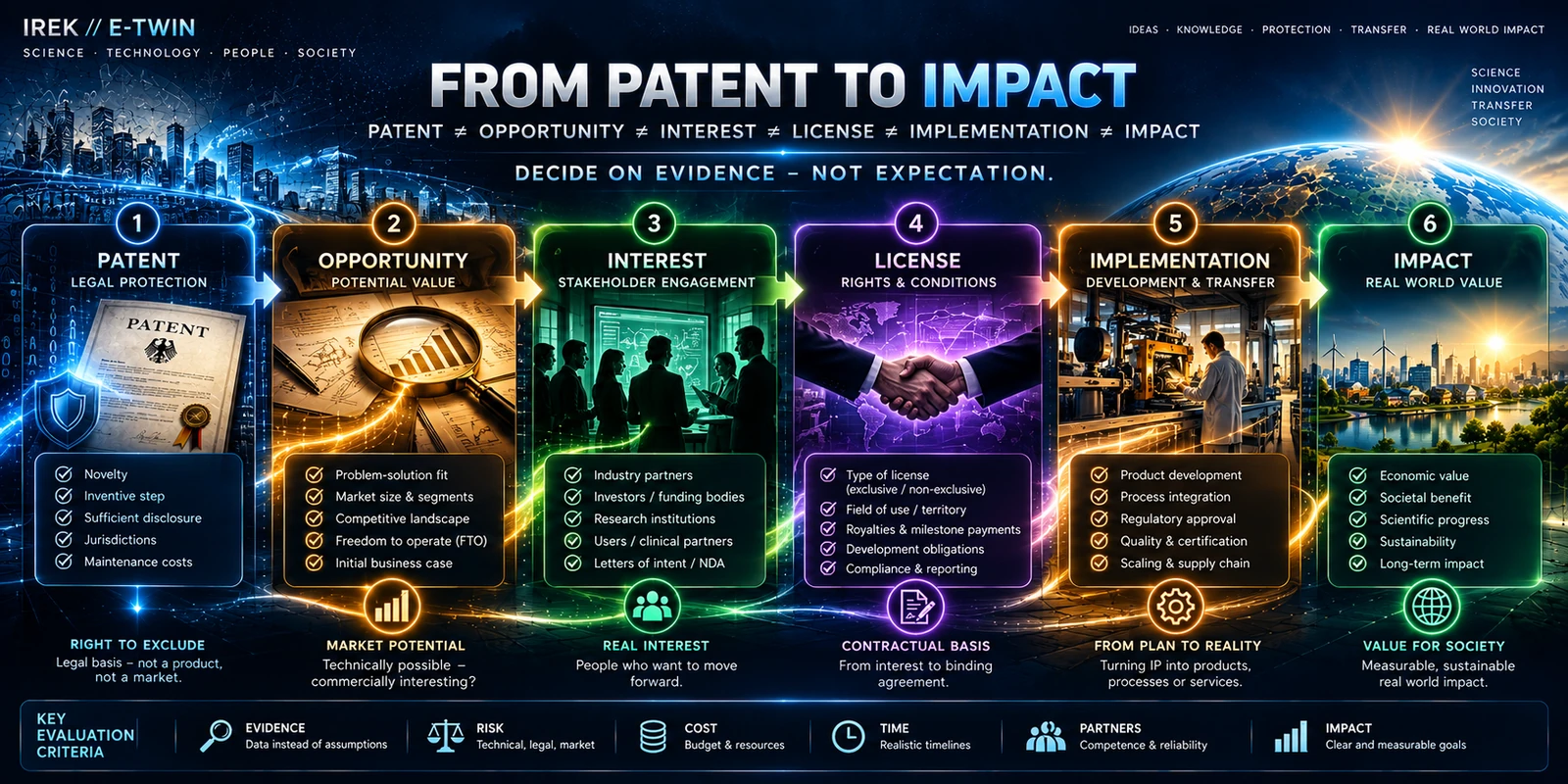
IMPACT
Impact is the final objective of the DA VINCI PATH — whether scientific, technological, economic or societal.
Protect what is worth protecting.
Transfer what is worth transferring.
Measure success where it actually happens.
DECIDE ON EVIDENCE — NOT EXPECTATION.