Listening to molecular relaxation.
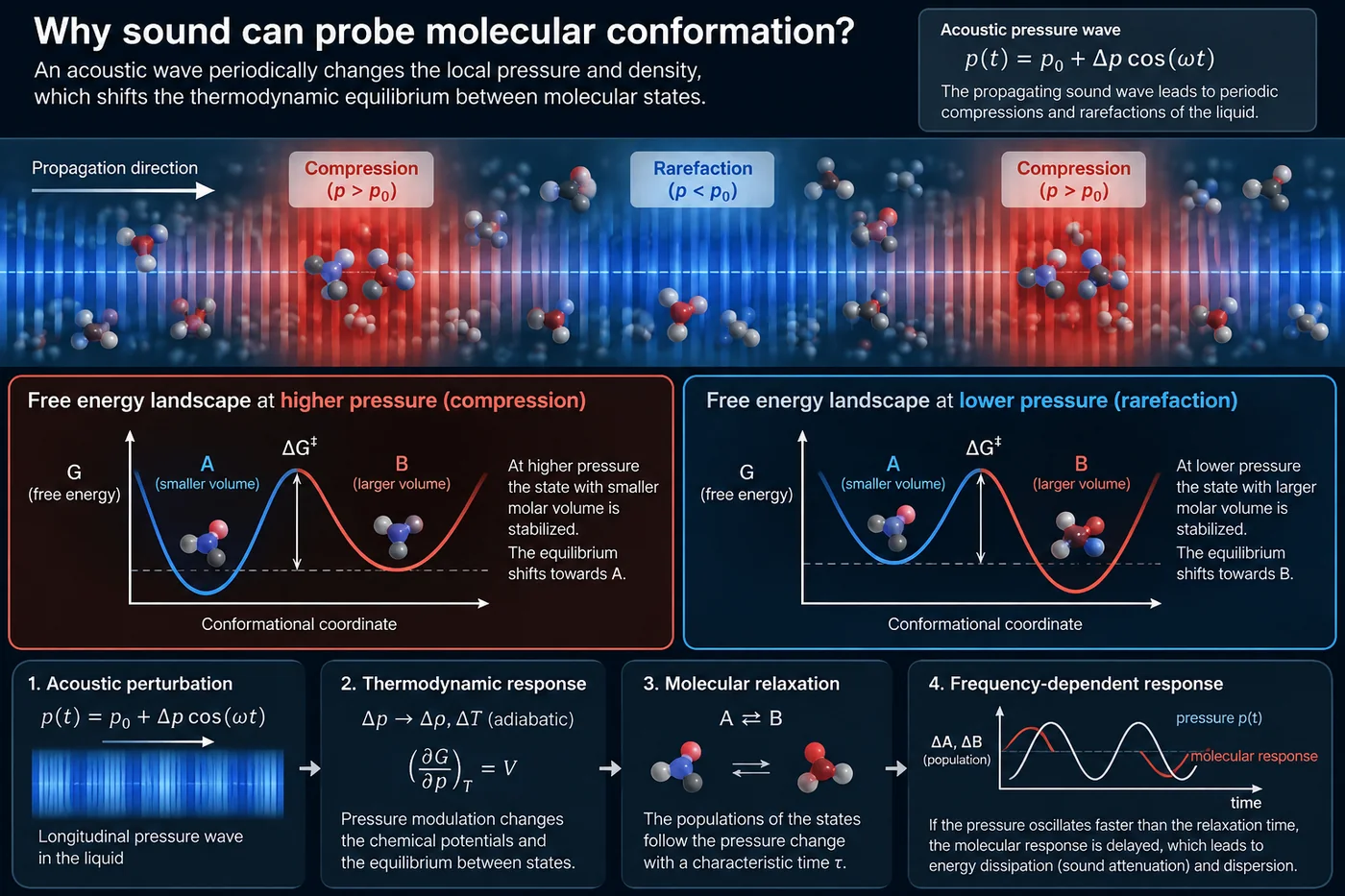
Ultrasonic spectroscopy uses the propagation of sound through a liquid to probe molecular and collective relaxation processes. A sound wave is not only a mechanical disturbance travelling through the sample: it produces periodic variations of pressure, density and temperature and therefore continuously perturbs the local thermodynamic state of the liquid.
If a molecular equilibrium is coupled to these thermodynamic variables, the equilibrium position changes during the acoustic cycle. The molecular system attempts to follow this periodic perturbation. Whether it can do so depends on the relation between the angular frequency of the sound wave and the characteristic relaxation time of the underlying process.
FROM SOUND TO THERMODYNAMICS
A sound wave propagating through a liquid produces alternating regions of compression and rarefaction. The local pressure therefore oscillates around its equilibrium value:
p(t) = p0 + Δp cos(ωt)
These pressure variations are accompanied by changes in density and, under approximately adiabatic conditions, temperature. The acoustic wave therefore acts as a small periodic thermodynamic perturbation of the liquid.
This becomes particularly important when a liquid contains molecular states whose free energies respond differently to pressure. At constant temperature, the pressure dependence of the Gibbs free energy is connected with the molar volume:
(∂G/∂p)T = V
Two molecular conformations with different molar volumes therefore do not respond identically to the acoustic pressure field. Compression and rarefaction periodically modify their relative free energies and consequently shift the thermodynamic equilibrium between them.
FROM THERMODYNAMIC PERTURBATION TO MOLECULAR RELAXATION
Consider two molecular states A and B connected by a reversible transition. If their molar volumes differ, a pressure change modifies the free-energy difference between the states. The equilibrium populations of A and B therefore change during each acoustic cycle.
The molecular populations, however, cannot generally adjust instantaneously. After a change of pressure, the system requires a finite time to approach its new equilibrium state. This characteristic time is the relaxation time τ.
For a simple first-order relaxation process, the response towards the instantaneous equilibrium may be written as
τ dy/dt + y = yeq(t)
At low acoustic frequencies, the molecular system has sufficient time to follow the changing equilibrium almost completely. At very high frequencies, the pressure changes too rapidly for the molecular populations to respond. The transition between these two limits occurs when the period of the acoustic perturbation becomes comparable with the molecular relaxation time.
THE DEBYE RELAXATION
The simplest description of such a single relaxation process is the Debye model. For a harmonic perturbation, the molecular response becomes frequency dependent and may be represented by a complex relaxation function:
R(ω) = 1 / (1 + iωτ)
The dimensionless product ωτ compares the time scale of the experiment with the intrinsic time scale of the molecular process. For ωτ ≪ 1, the system follows the acoustic perturbation almost in equilibrium. For ωτ ≫ 1, the molecular response can no longer follow the rapidly oscillating pressure field.
Around ωτ ≈ 1, the response develops a significant phase lag. Energy is dissipated during every acoustic cycle, producing a characteristic contribution to ultrasonic attenuation. At the same time, the transition between the relaxed and unrelaxed response produces dispersion of the sound velocity.
FROM MOLECULAR RELAXATION TO AN ULTRASONIC SPECTRUM
Molecular relaxation is therefore not observed at a single acoustic frequency. Its characteristic response extends over a frequency range determined by the relaxation time. Broadband ultrasonic spectroscopy combines measurements performed over different frequency ranges into a common relaxation spectrum.
No single experimental technique conveniently covers this entire range. Resonator and ultrasonic transmission methods provide complementary frequency windows, with overlapping regions allowing the different techniques to be connected into one broadband spectrum.
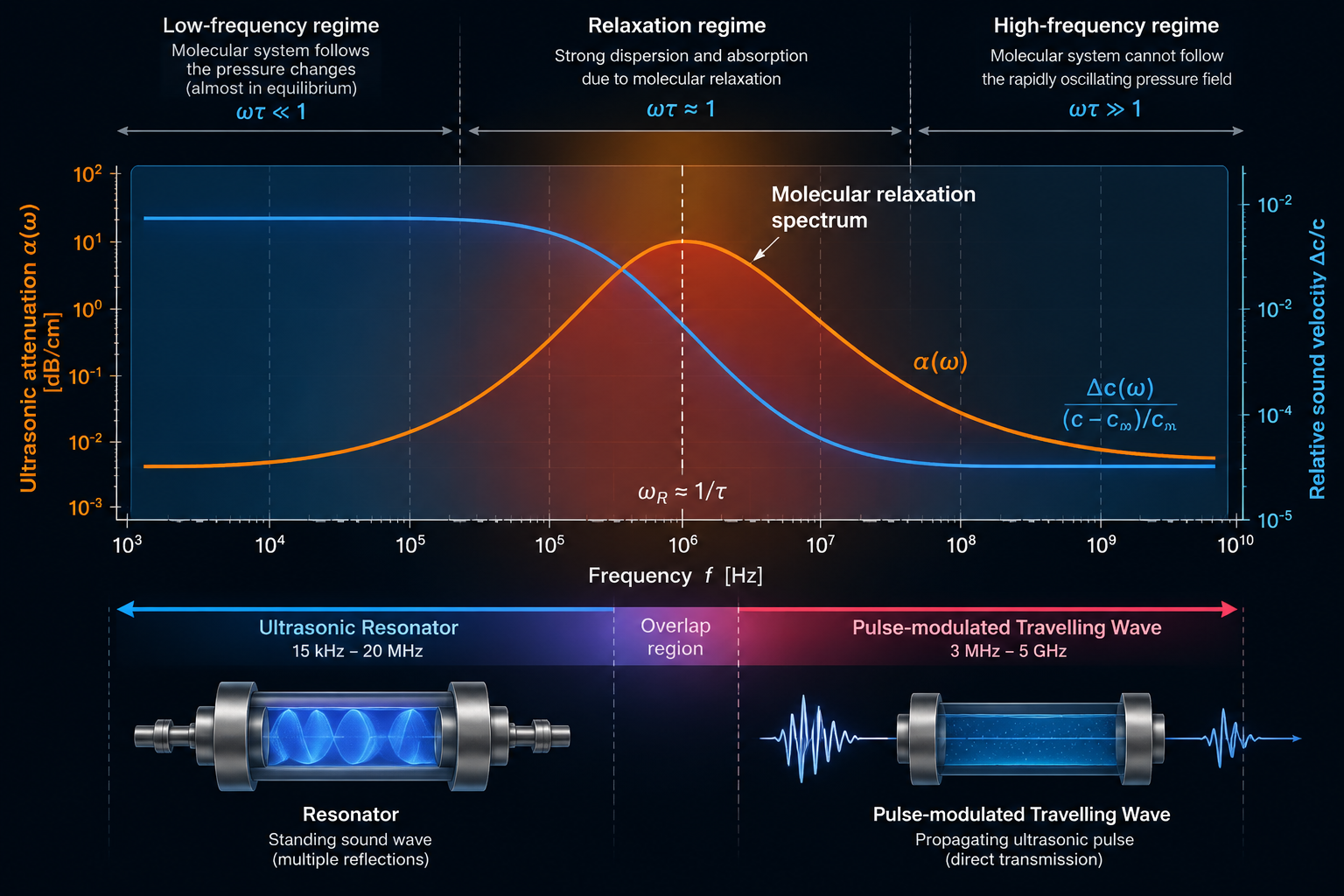
The experimental question is therefore no longer only what does the molecular system do?, but also how can its relaxation be measured over such a wide range of time scales?
How these frequency ranges are accessed experimentally begins with the ultrasonic resonator.